ByJohn A
AI Pickleball Machines: Features Every Player Should Know
Pickleball’s rapid growth has brought a wave of new training equipment to market, and not all of it is built the same way. Some machines are little more than motorized feeders with a few speed settings, while others incorporate genuine AI capabilities that change how effective solo practice can actually be. For players trying to decide what’s worth paying for, understanding which features matter — and why — makes the difference between a useful investment and an expensive novelty.
Programmable Ball Delivery: The Foundation
Before evaluating anything AI-related, it’s worth starting with the basics, since even advanced machines are built on top of solid ball-delivery mechanics. An AI pickleball machine worth considering should support a wide range of shot types — drives, serves, dinks, drops, cross-court dinks, and lobs — along with adjustable speed, spin, and feed intervals. Without this foundation, more advanced AI features don’t add much value, since there’s little variation to work with in the first place.
AI Vision and Ball-Landing Analysis
This is where things start to genuinely differentiate from basic ball machines. AI vision systems use cameras to track shots in real time, enabling ball-landing analysis that tells players exactly where a shot landed rather than relying on visual estimation. For players trying to tighten up shot placement — a critical skill in a sport largely decided at the kitchen line — this kind of objective feedback is difficult to replicate without a coach standing court-side.
This feature matters most for intermediate and advanced players refining precision, though even newer players benefit from understanding early on whether their shots are consistently landing where intended.
See also: How Technology Is Changing the Way We Preserve Family Memories
Training and Challenge Modes
Static, repetitive feeding only builds so much skill. AI training and challenge modes introduce variation and unpredictability designed to mimic how a real point might unfold — varying shot placement, pace, and sequencing rather than repeating identical patterns indefinitely.
This feature is particularly valuable for competitive players, since match play rarely rewards players who’ve only practiced against predictable, fixed feeds. Being able to react to varied, semi-unpredictable shot sequences builds adaptability that transfers more directly to actual games.
Real-Time Feedback Systems
Beyond post-shot analysis, some machines offer real-time feedback during a session itself — LED indicators or app notifications that respond immediately to shot outcomes. This creates a tighter feedback loop: hit a shot, get instant information, adjust on the next attempt. For players training without anyone else present to offer input, this immediate feedback loop is one of the more genuinely useful AI-driven features available.
Voice and App Control
It’s easy to overlook control systems as a “feature,” but for AI-heavy machines with multiple modes and settings, being able to switch between them without manually adjusting the machine matters significantly. Voice control in particular allows players to change drills mid-session without breaking practice rhythm, which becomes increasingly important as sessions involve more complex, adaptive training modes rather than simple fixed feeds.
Ball Capacity and Session Continuity
AI features are only useful if a session can run long enough to take advantage of them. Machines with higher ball capacity — commonly 75 or more balls — reduce how often practice needs to pause for reloading, which matters more for adaptive training modes that benefit from sustained, uninterrupted repetition to build real skill development.
Looking Beyond Pickleball: Where This Technology Is Headed
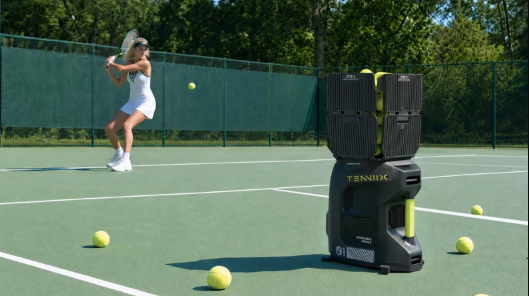
It’s worth noting that the same underlying AI capabilities driving pickleball innovation are also advancing rapidly in other racquet sports. Full AI opponent simulation — where a training system can adjust positioning and shot patterns to more closely mimic a real opponent — represents one of the more advanced directions this technology is heading, combining vision tracking with dynamic movement capabilities. Understanding this broader trajectory helps put current pickleball-specific AI features into context: what’s available today is likely to keep expanding as sensing and mobility technology matures further.
Which Features Actually Matter for Your Level
Not every player needs every feature immediately:
- Beginners benefit most from adjustable shot variety and speed — the foundation everything else builds on.
- Intermediate players get the most value from ball-landing analysis and real-time feedback, which help correct specific technical issues.
- Competitive players benefit most from adaptive training and challenge modes, since these most closely mirror unpredictable match conditions.
Final Thoughts
AI-driven pickleball machines offer meaningfully more than basic ball feeders, but not every feature matters equally for every player. Understanding what ball-landing analysis, adaptive training modes, and real-time feedback actually do — rather than treating them as generic marketing terms — helps players choose equipment that genuinely fits their training goals rather than paying for capabilities they won’t use.
FAQs
1. What’s the difference between a basic ball machine and an AI pickleball machine? AI machines incorporate vision tracking and adaptive features like ball-landing analysis and training modes that respond to actual play, rather than simply repeating a fixed feed pattern.
2. Is ball-landing analysis useful for beginners? It’s most valuable for players who already have consistent contact and want to refine shot placement, though even beginners benefit from understanding early shot accuracy trends.
3. Why do training and challenge modes matter? They introduce unpredictability that mimics real match conditions, helping players develop adaptability rather than only practicing against fixed, repetitive patterns.
4. How important is ball capacity for AI-driven machines? Higher capacity supports longer, uninterrupted sessions, which matters more for adaptive training modes that benefit from sustained repetition.
5. Are advanced AI features only useful for competitive players? While competitive players benefit most from adaptive and challenge modes, features like real-time feedback and shot analysis are useful across a range of skill levels.