ByJohn A
AI-Powered Credit Scoring: Building Alternative Scoring Models Beyond FICO
| Table of Contents 1. Why FICO Leaves Money and Borrowers on the Table 2. What AI Credit Scoring Actually Changes 3. The Fuel: Alternative Data That Predicts Repayment 4. The Engine: Which Models to Use and Why 5. The Catch: Explainability and Adverse-Action Reasons 6. The Risk: Bias, Fairness, and How to Test for It 7. The Rulebook by Region: US, UK, EU, UAE, India 8. Tech Stack, Cost, and How to Build It Right 9. Frequently Asked Questions |
There are roughly 26 million Americans that the credit bureaus cannot score at all, plus tens of millions more with thin files who get rejected or overpriced, and most of them are perfectly creditworthy. FICO cannot see them because it relies on a fixed set of bureau data points weighted by a fixed formula.
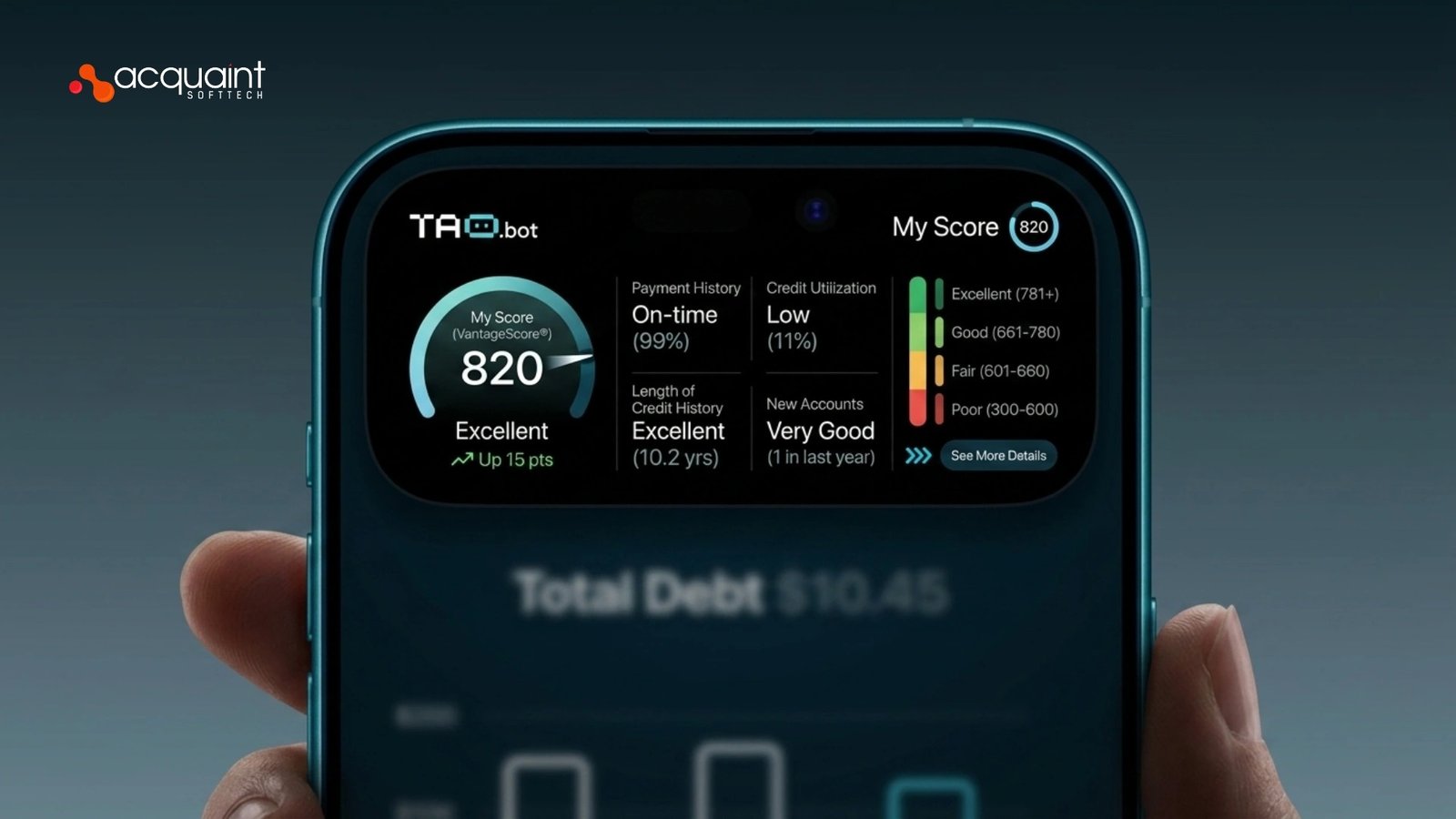
AI-powered credit scoring changes that by learning from far broader signals, cash flow, rent, utilities, and behavior, to judge who will actually repay. Building an alternative scoring model beyond FICO is not just a machine-learning problem; it is the harder challenge of being accurate, explainable, and fair all at once.
Acquaint Softtech’s AI development services build these models for lending clients across the USA, UK, Europe, UAE, and India. The business case is striking.
By incorporating alternative data, AI scoring can lift loan approvals by 20 to 40% for previously unscorable borrowers, and one study found a bank could lend to 77% more people at the same default rate simply by switching to a more accurate AI model, according to 2026 lending research.
Acquaint Softtech has delivered 1,300+ software projects across 20+ industries in 13+ years, with 70+ in-house engineers, and clients deploy AI and data engineers within 48 hours of a brief. For the full lending-platform picture, start with the guide on how to build a digital lending platform, and the broader guide for your guide to FinTech Software Development.
Why FICO Leaves Money and Borrowers on the Table
FICO leaves money on the table because it can only score people who already have a bureau history, and it judges them with a fixed formula that ignores most of what predicts repayment. Traditional models use a set of bureau data points, payment history, utilization, and length of history, weighted by predetermined percentages, so anyone with a thin or absent file is invisible or penalized.
That excludes around 26 million credit-invisible US adults and millions of solid earners with short histories. Teams that hire dedicated developers with risk-modeling experience build models that see these borrowers.
The deeper limitation is that FICO is static and backward-looking. It updates slowly, reflects past mistakes more than present behavior, and cannot adapt to changing conditions without a slow, manual scorecard rebuild. A borrower can look weak in FICO, yet show months of steady income and disciplined spending in their bank data, exactly the signal a lender wants and FICO misses. Capturing that signal is a core AI development task, not a tweak to an existing scorecard.
For a lender, this is not just a fairness story; it is revenue. Every creditworthy applicant FICO cannot score is a loan a competitor with a better model will write. For a wider view of how to choose a partner to build that model, this roundup of top MERN stack development companies in India breaks down the criteria that matter.
What are the limitations of FICO credit scores?
FICO’s main limitations are that it only scores people with an existing bureau history, leaving around 26 million credit-invisible US adults unscorable, and that it uses a fixed formula weighted by predetermined percentages that is slow to update and backward-looking. It reflects past mistakes more than present behavior and cannot adapt to changing conditions without a manual scorecard rebuild, so it misses many creditworthy thin-file borrowers.
What AI Credit Scoring Actually Changes
AI credit scoring changes three things: the data it can use, the patterns it can find, and the speed at which it decides. Instead of a fixed formula, a model is trained on historical loan outcomes, can ingest alternative data, finds non-linear patterns a human-designed scorecard never would, and keeps learning as conditions change. The result is more accurate risk assessment for a far broader population. Acquaint Softtech’s Python developers build the data pipelines and models that turn this capability into live decisions.
Speed is the visible difference. Traditional underwriting with manual review can take days; AI decisioning processes applications in milliseconds, with leading platforms handling over 700,000 decisions a day at under 800 milliseconds each. For a fintech competing on experience, instant decisions are a product feature, not just an efficiency gain. Building decisioning at that latency is a specialized software product engineering services capability.
The value compounds across the whole credit lifecycle, not just the initial decision: the same models sharpen pricing, limit-setting, early-warning monitoring, and collections. The data-pipeline patterns behind feeding these models are explained in this MERN stack complete guide (part 2).
How is AI credit scoring different from traditional scoring?
Traditional scoring like FICO uses a fixed set of bureau data points weighted by predetermined percentages. AI credit scoring is trained on historical loan outcomes, can incorporate alternative data such as cash flow and rent, identifies non-linear patterns a static scorecard cannot, and updates as conditions change. It also decides in milliseconds rather than days, and improves pricing, monitoring, and collections across the whole credit lifecycle.
To build such intelligent, scalable lending solutions, many businesses choose to work with experienced teams and hire MERN Stack developers from Acquaint Softtech for faster development and seamless integration of AI-driven features.
The Fuel: Alternative Data That Predicts Repayment
An AI model is only as good as the data it learns from, and alternative data is the fuel that lets it see borrowers FICO misses. The most powerful source is cash-flow data from authenticated bank transactions, which gives a granular, objective view of real income and spending, with models reaching documented accuracy of around 95% in identifying salary streams. Around that sit rent, utility, and telecom payment histories, all strong repayment signals that bureaus often ignore.
- Cash-flow data: categorized bank-transaction data showing real income and spending, the single strongest alternative signal.
- Rent and utilities: on-time rent, electricity, and telecom payments demonstrate reliability for thin-file borrowers.
- Behavioral and digital signals: verified digital footprint and account behavior add predictive lift when used carefully.
- Open banking feeds: consented account access provides fresh, structured data without manual document collection.
The catch is that more data also means more risk: some alternative signals correlate with protected attributes like race or gender, so the data layer is where fairness problems are born or prevented. Choosing predictive, defensible features and documenting why each is included is as important as the modeling itself, which is why this is core AI development work.
Read Also: AI Pickleball Machines: Features Every Player Should Know
What data does AI credit scoring use?
AI credit scoring uses alternative data beyond the credit bureau: cash-flow data from authenticated bank transactions (the strongest signal, with around 95% accuracy in detecting salary), rent, utility, and telecom payment histories, verified behavioral and digital-footprint signals, and consented open-banking feeds. These let the model assess thin-file borrowers on real financial behavior, though features must be chosen carefully to avoid correlating with protected attributes. Building and integrating such advanced scoring systems often requires experienced development teams, which is why many fintech companies choose to hire MEAN Stack developers for scalable, data-driven platforms.
The Engine: Which Models to Use and Why
The model at the center of most production credit-scoring systems is gradient-boosted trees, with XGBoost the common choice because it performs strongly on the structured, tabular data lending produces. It outputs a default probability, which the lender turns into approve, decline, or price decisions against its own risk appetite.
In benchmarks across public lending datasets, XGBoost reaches an AUC of roughly 0.89 to 0.92, showing strong separation between risky and safe borrowers. Acquaint Softtech’s Python developers train, calibrate, and validate these models on real loan-outcome data.
There is no single right model; the choice trades accuracy against control. Pure machine-learning models maximize prediction but can be harder to interpret. Hybrid models balance accuracy and transparency, making them ideal for regulated industries. Generative AI is also being used for scenario simulation and document analysis, while white-label software development solutions can help speed up deployment. Choosing the right approach depends on your risk and compliance requirements.
| Model Type | Strength | Trade-off |
| Gradient boosting | Best on tabular data | Needs explainability layer |
| Neural networks | Complex patterns | Hardest to interpret |
| Hybrid (rules + ML) | Control plus accuracy | More to maintain |
| Logistic regression | Fully interpretable | Lower predictive power |
A pragmatic pattern is to start with an interpretable baseline, then move to gradient boosting with a strong explainability layer once you can prove fairness and stability. The framework decision behind a maintainable model-serving stack is compared in this guide on Laravel vs MERN stack for startups.
What is the best model for AI credit scoring?
Gradient-boosted trees, especially XGBoost, are the most common choice because they perform strongly on the structured, tabular data lending produces, reaching an AUC of about 0.89 to 0.92. Organizations building and deploying these AI-driven lending systems often work with experienced teams that can integrate, customize, and scale machine learning solutions with the help of dedicated Laravel experts, making services like hiring Laravel developers from Acquaint Softtech a practical option. Pure neural networks capture complex patterns but are hardest to interpret, while hybrid models combine rules with machine learning for control plus accuracy. The right pick balances predictive power against the explainability your regulator requires.
The Catch: Explainability and Adverse-Action Reasons
Here is the catch that sinks many AI credit projects: a model that cannot explain its decisions cannot legally be used. The fix is SHAP-based explainability, which shows exactly why a decision was made. Acquaint Softtech’s AI developers integrate these explanations into the decisioning flow, and businesses can also use its staff augmentation services to quickly add AI talent while ensuring compliance and transparency.
Explainability works at two levels. For regulators and auditors, SHAP and LIME provide a feature-level audit trail satisfying documentation requirements; for declined customers, the same tooling generates the plain-language reasons an adverse-action notice needs. The subtlety is that explanations must be stable: if feature attributions swing wildly between model retrains, the adverse-action reasons become indefensible, so explanation robustness is a real engineering requirement, not a checkbox. Building this is core software product engineering services.
Use explainability tooling such as SHAP or LIME, which shows exactly which features drove each decision and by how much. For regulators and auditors, it provides a feature-level audit trail; for declined customers, it generates the plain-language adverse-action reasons required under ECOA and FCRA. Explanations must be stable across retrains, so attributions stay consistent and the reasons remain legally defensible.
The Risk: Bias, Fairness, and How to Test for It
AI credit models do not invent bias, but they absorb the bias in their training data and can amplify it through proxy features, so fairness must be engineered deliberately. The naive fix, simply dropping gender and ethnicity, fails because other features can still act as proxies for protected attributes; this fairness-through-unawareness approach is a well-known trap. Real fairness requires active testing and mitigation throughout the development lifecycle. Organizations often choose to hire developers with expertise in AI and compliance to address these challenges. Acquaint Softtech’s AI developers build fairness testing and bias mitigation directly into the model pipeline, helping ensure more transparent and equitable credit decisions.
Fairness is measured, not assumed. Teams track metrics like statistical parity difference and equal-opportunity difference across demographic groups, then mitigate, for example, with SHAP-based regularization that penalizes predictions correlating with protected attributes. The evidence is nuanced: research on millions of US mortgages found algorithmic lenders discriminated meaningfully less than human ones, yet still produced pricing gaps, so fairness is a continuous discipline, not a one-time pass. Embedding it is core AI development work.
The payoff is both ethical and commercial: a fairer model expands access to credit for millions previously excluded while reducing legal and reputational risk. Done well, fairness and accuracy reinforce each other rather than trade off. The MVP-first approach that lets you validate a model on one segment before scaling is documented in this story on how a startup saved $60K a year on remote hiring.
How do you make an AI credit model fair?
Make it fair by measuring and mitigating bias, not by dropping protected attributes, since other features can act as proxies. Track fairness metrics like statistical parity difference and equal-opportunity difference across demographic groups, then apply mitigation such as SHAP-based regularization that penalizes predictions correlating with protected attributes. Fairness is a continuous discipline tested at every retrain, not a one-time check, and it expands credit access while cutting legal risk.
The Rulebook by Region: US, UK, EU, UAE, India
Where you lend decides which rules govern your model, and the bar is rising everywhere. The good news is that the requirements rhyme: accuracy, explainability, fairness, and an audit trail, so a single strong governance framework can satisfy most markets. Acquaint Softtech’s AI developers build to each regulator’s documentation and fairness expectations.
- USA: ECOA, the Fair Credit Reporting Act, and Regulation B require specific adverse-action reasons and fair-lending compliance, with CFPB oversight; SR 11-7 governs model risk for banks.
- UK: FCA fair-lending and Consumer Duty expectations apply, with UK GDPR governing the personal data and automated-decision rights of applicants.
- Europe: credit scoring is high-risk under the EU AI Act, with Article 13 transparency duties, plus GDPR rights around automated decisions; the strictest regime to design for.
- UAE: Central Bank and free-zone (DIFC, ADGM) frameworks expect explainability and sound model governance, with growing alignment to global AI-governance norms.
- India: RBI fair-lending practices and the Digital Lending Directions govern model-driven decisions, with the DPDPA shaping how borrower data may be used.
The practical move for multi-region lenders is to anchor a single compliance framework to the EU AI Act, because its pre-market controls and lifecycle governance are stricter than the US outcome-focused regime, so meeting EU standards covers most CFPB and Regulation B requirements too.
A complete audit trail, model purpose, data lineage, feature rationale, validation, bias testing, adverse-action mapping, and retraining history are the deliverables every regulator expects. Building it once is efficient software development outsourcing, and the lending-platform context around it.
| Region | Key Rules | Core Demand |
| USA | ECOA, FCRA, Reg B | Adverse-action reasons |
| UK | FCA, UK GDPR | Fair lending, data rights |
| Europe | EU AI Act, GDPR | High-risk governance |
| UAE | Central Bank, DIFC | Explainability, governance |
| India | RBI, DPDPA | Fair lending, data use |
Is AI credit scoring legal and regulated?
Yes, and the rules are tightening. In the US, ECOA, FCRA, and Regulation B require specific adverse-action reasons and fair-lending compliance under CFPB oversight; the EU classifies credit scoring as high-risk under the AI Act with strict transparency duties; the UK applies FCA and UK GDPR rules; the UAE expects explainability and governance; and India applies RBI fair-lending practices and the DPDPA. A single framework anchored to the EU AI Act covers most markets.
Tech Stack, Cost, and How to Build It Right
The tech stack for AI credit scoring is Python-centric: Python with libraries like XGBoost and scikit-learn for modeling, SHAP for explainability, pandas and a feature store for data, and an API layer that serves real-time scores into the lending flow. A central feature store, a shared SHAP-based explanation engine, and a unified audit trail let one system serve multiple regulators at once. Acquaint Softtech assembles this through its AI development services, supported by its Virtual CTO Services, which help organizations define architecture, governance, and AI adoption strategies while providing the data engineering needed to power the platform.
Cost depends on data readiness and regulatory scope. A focused alternative-scoring model and decisioning API, built on existing data with one market’s compliance, typically runs $60,000 to $150,000, while a multi-market system with full governance, fairness tooling, and integrations runs higher. The highest hidden cost is data work, sourcing, cleaning, and labeling, not the modeling itself.
The right path is to start with a pilot on one segment, prove accuracy and fairness against your current model, then expand, with monitoring for accuracy, bias, and drift baked in from day one. Founders building these systems often have developers with ML and risk experience to get the model and the governance right together.
| Layer | Recommended Tech | Role |
| Modeling | Python, XGBoost | Train the scoring model |
| Explainability | SHAP, LIME | Adverse-action reasons |
| Data | Feature store, pandas | Pipelines and features |
| Serving | API, real-time | Score into lending flow |
How much does it cost to build an AI credit scoring model?
A focused alternative-scoring model and decisioning API, built on existing data for one market’s compliance, typically costs $60,000 to $150,000, while a multi-market system with full governance, fairness tooling, and integrations costs more. The highest hidden cost is data work, sourcing, cleaning, and labeling, rather than modeling. India-based teams at $25 to $49 per hour cut total cost by up to 40% versus US agencies.
Frequently Asked Questions
What is AI credit scoring?
AI credit scoring uses machine learning and alternative data, such as bank transactions, rent, and utility payments, to assess creditworthiness more accurately than traditional credit scoring models.
How much does it cost to build AI credit scoring?
A custom AI credit scoring solution typically costs:
- USA: $60,000–$150,000+
- UK: £50,000–£120,000+
- Europe: €55,000–€140,000+
Note: Advanced multi-market platforms with governance and compliance features cost more.
What data does AI credit scoring use?
AI credit scoring uses bank transaction data, rent payments, utility bills, telecom records, open banking data, and other verified financial behavior signals.
Is AI credit scoring fair?
AI credit scoring can reduce human bias, but fairness depends on data quality, model monitoring, and regular bias testing to prevent discrimination.
How long does AI credit scoring development take?
A pilot AI credit scoring system usually takes 3–5 months, while a production-ready platform with integrations and compliance features can take 6–12 months.
What is the best tech stack for AI credit scoring?
Python is the preferred choice, using XGBoost, scikit-learn, pandas, SHAP, and LIME for modeling, explainability, and risk assessment.